

Article 3 of 6 from the Series - P2P for Large AD Generators
In the previous article, we explored why some corporate buyers are willing to pay more for traceable, renewable electricity.
That naturally leads to the next question:
How Can This Opportunity Be Explored Without Creating Unnecessary Risk?
For most large AD operators, existing commercial arrangements are already working effectively.
PPAs, optimisation strategies and route-to-market agreements are established, familiar and commercially proven.
Any new opportunity therefore needs to answer a simple test:
Can additional value be accessed without disrupting what already works?
The Starting Principle: Addition, Not Replacement
The most important point is this: P2P should be viewed as an overlay, not a replacement.
The objective is not to restructure an entire portfolio. Instead, selected volumes of generation can be allocated to P2P transactions while most of the output continues to follow existing routes.
This enables:
- Direct performance comparison
- Minimal disruption
- Evidence-based decision making
In other words, value can be tested before wider adoption is considered.
Start Small, Then Expand Only If Proven
P2P does not require a large-scale commitment.
Many portfolios begin with:
- A small proportion of generation
- A limited number of assets
- Clearly defined volumes
Performance can then be benchmarked against existing arrangements. If additional value is demonstrated, participation can increase gradually.
If it is not, existing routes remain available. This creates a measured and controlled path to adoption.
Why the “Many-to-Many” Model Matters
In the previous article, we illustrated how a P2P platform connects multiple generators with multiple corporate consumers.
That same structure also provides an important risk-management benefit. Rather than relying on a single buyer, generation can be matched across multiple corporate consumers.
This helps diversify exposure and reduces dependence on any individual counterparty.
The same structure that creates access to premium demand can also help distribute commercial risk.
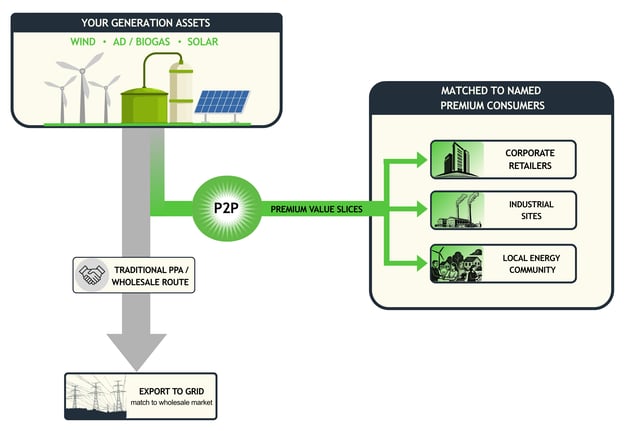
The many-to-many structure increases commercial flexibility and reduces concentration risk.
Working Alongside Existing Commercial Teams
A common misconception is that P2P replaces existing commercial arrangements. In reality, successful implementation depends upon the expertise of:
- Commercial teams
- Optimisation teams
- Traders
- Route-to-market partners
These stakeholders understand your asset performance, operational constraints and revenue objectives better than anyone.
P2P simply provides an additional tool that can help them improve outcomes. The objective is partnership, not replacement.
Operational Impact is Minimal
Importantly, introducing P2P does not require:
- New physical infrastructure
- Changes to generation assets
- Different operating practices
The opportunity is largely commercial rather than operational.
Generation continues as normal while selected volumes are allocated differently.
The Key Takeaway
The most important idea in this article is simple: P2P does not need to be an all-or-nothing decision.
It can be introduced gradually, measured carefully and expanded only where value is proven.
For large AD operators, this creates a practical way to explore additional revenue opportunities, while retaining existing commercial arrangements and maintaining control.
* * *
|
Next in the Series - P2P for Large AD Generators: How does it work with traders, route-to-market providers and other established commercial partners?
Next in this series, we'll go over how P2P can sit alongside existing arrangements. Read the next article - How P2P Supports Existing Commercial Arrangements, or check the full series here. |