

Article 5 of 6 from the Series - P2P for Large AD Generators
In the previous article, we explored how P2P can provide existing commercial teams with additional options when deciding where generation should be allocated.
This naturally leads to the next question:
How Do These Additional Options Create Incremental Value?
The answer lies in recognising that different consumers value electricity differently, and that those requirements can change over time.
For many large AD operators, the opportunity is not simply about finding a new buyer, rather, it's about matching different elements of generation output with different strands of demand.
Creating Premium Baseload Revenues
Many industrial and commercial consumers have substantial, predictable electricity requirements. Increasingly, these organisations are seeking long-term access to provably clean, traceable power.
This creates an opportunity for AD generators to allocate a selected portion of their baseload generation to these buyers. Importantly, this does not require the entire portfolio to be committed.
A generator may choose to allocate only a modest proportion of its output to P2P arrangements, whilst retaining the remainder within existing contracts and optimisation strategies.
The objective is to secure premium recurring revenues from highly motivated consumers, whilst maintaining commercial flexibility.
The illustration below shows the annual half-hourly consumption of a large industrial consumer (blue line), with a summer baseload of approximately 16MW, with winter creeping up to 30-40MW.
The purple line shows the consumption matched with a total of 18MW of AD generation (sourced from multiple AD generation assets, enabled using our P2P Energy Trading Platform).
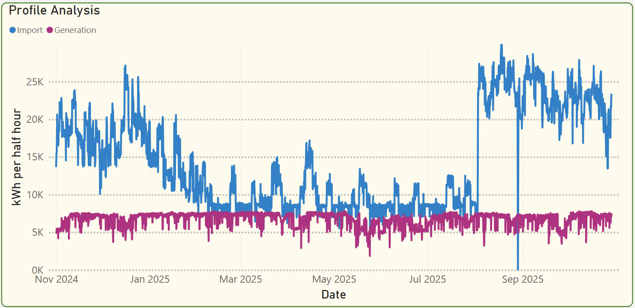
Large energy users often have significant and predictable baseload requirements that can be matched with renewable generation.
One important observation emerges from this profile. Even the customer's minimum demand substantially exceeds the output of a single AD plant.
As a result, the customer may seek supply from multiple renewable generators simultaneously.
This allows both parties to participate within a wider ecosystem of renewable generation, rather than depending on a single supplier relationship.
Looking Beyond Baseload
Baseload demand is only part of the picture.
Many large consumers also experience regular changes in demand driven by operational activity, production schedules or business cycles. These changes create additional commercial opportunities.
The same customer whose baseload demand creates recurring revenue may also require additional electricity during specific periods when consumption increases.
For generators with flexibility in their operations, or with spare generation capacity available, this creates another potential destination for their power.
From Fixed to Dynamic Allocation
The chart below shows the same industrial customer’s demand over a shorter period of time.
On top of the baseload requirement, the consumption shows lots of ‘spikes’, both intra-day and between days.
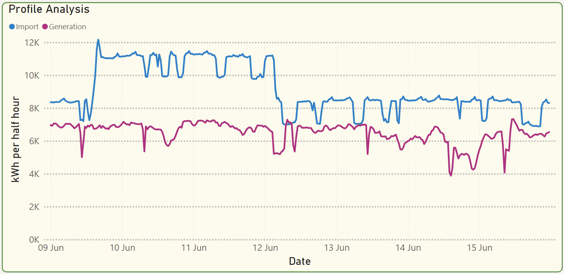
Short-term changes in demand can create additional opportunities for generators with available capacity.
Looking backwards in time, these demand spikes may look quite random, but in reality they are very predictable between one day and one week ahead of time, based on production schedules.
This creates opportunities for corporate consumers to signal additional demand requirements and for generators to evaluate whether participation creates more value than alternative routes to market.
Importantly, this is not an either/or decision. Existing optimisation teams remain free to determine how available generation should be allocated between:
- Existing contractual commitments
- Wholesale markets
- Flexibility services
- P2P opportunities
P2P simply introduces another option into that decision-making process.
Working Within Operational Realities
Of course, every generation asset operates within constraints.
AD operators must consider factors such as:
- Feedstock availability and throughput
- Gas production and storage capacity
- CHP performance and flexibility to ramp up or down
- Maintenance requirements
- Existing contractual obligations
The optimisation strategy takes account of these realities.
The objective is to identify where existing operational flexibility and available capacity can be matched with commercial opportunities that create additional value.
Multiple Layers of Value
The most interesting aspect of the example above is that it demonstrates two different opportunities from the same customer. The first comes from securing part of the customer's recurring baseload requirement. The second comes from responding to changes in that customer's short-term demand.
The power of this ecosystem is that consumers can match their demands across multiple generators; and generators can match with multiple consumers. This creates a fluid market, optimising efficiency and pricing for all participants.
P2P is not simply about selling electricity: it is about creating additional ways for existing commercial teams to capture value from generation assets.
The Key Takeaway
The most important idea in this article is simple: Additional value is created by matching different types of generation with different types of demand.
Some opportunities arise from predictable baseload requirements. Others emerge from short-term changes in demand.
The more premium-priced options commercial teams have available, the more effectively they can allocate generation to maximise overall portfolio value.
* * *
|
Next in the Series - P2P for Large AD Generators: Throughout this series we have explored: - Why some buyers pay more The natural final question is: What could this be worth to my organisation?Read the next article - Quantifying the Full Value Opportunity, or check the full series here. |